50 Years of Speaking Hope | Part 1 (Long Read) – By Geoffrey Otieno
Before there was TWR Kenya, there was a young Ghanaian. He faced closed doors, found a German adoptive mother, crossed paths with a broadcasting pastor, and carried a conviction that refused to die. It was the beginning of a legacy that would outlive the man who carried it.
A Reluctant “Yes”
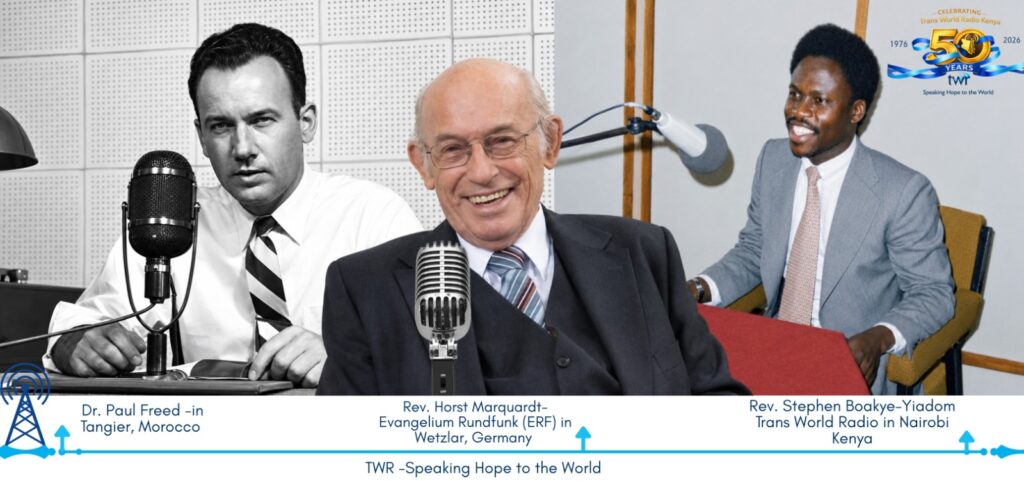
In 1952, when Dr. Paul Freed, the founder of Trans World Radio, first sensed God’s call to reach the people of Spain, he could not have imagined what would eventually grow from his response. He later described his first step as a “very puny, reluctant ‘yes’.” That hesitant yes became the beginning of a remarkable global media ministry. With one small transmitter in Tangier, Morocco, TWR went on air on February 22, 1954. From that modest beginning, the ministry would eventually reach across continents, cultures and languages.
But great ministries are rarely built in one dramatic moment. They grow through people who respond to a calling, partnerships that cross borders and, sometimes, through doors that remain closed until the right moment.
For TWR Kenya, one of those people was Rev. Stephen Boakye-Yiadom. One of those partnerships was with Rev. Horst Marquardt, a German pastor and broadcaster who would become Stephen’s friend, mentor and fellow worker in the expansion of TWR ministry across Africa.
Their story did not begin with an established studio, a transmitter or a large team. It began with a young Ghanaian looking for an opportunity and being told No.
A Young Man in Germany
Born in Kumasi, Ghana to a cocoa farmer, on 21 July 1943, Rev. Stephen Boakye-Yiadom initially followed a very different path from the one that would eventually lead him into Christian broadcasting. After completing his schooling, he worked in a local bank before leaving Ghana for Germany to pursue further studies in 1970.
His first ambition was to study accounts in the United States. His second choice was Europe, and Germany appealed to him for another reason too: football. The young Ghanaian dreamed of becoming a professional footballer. Germany, however, would give Rev. Stephen something far more significant than an education or a connection to Bundesliga football. It would become the place where his life and calling began to take a new direction.
Rev. Stephen became part of a church fellowship where he met people who would unexpectedly influence the course of his life. Among them was Mrs. Herta Wojahn who became motherly influence in his life, a kind German Christian woman who had a heart for welcoming foreigners into her home.
Rev. Stephen was hard to miss. He had a warm, toothy smile that revealed bright, snow-white teeth, and a thick thatch of deep jet-black hair the distinctive “Afro” hairstyle of the time. His youthful warmth and cheerful personality quickly made him special to Herta.She often opened her doors to young people from other countries, offering them food, fellowship and a place where they could feel at home far from their own families. Together they would listen to Christian radio broadcasts.
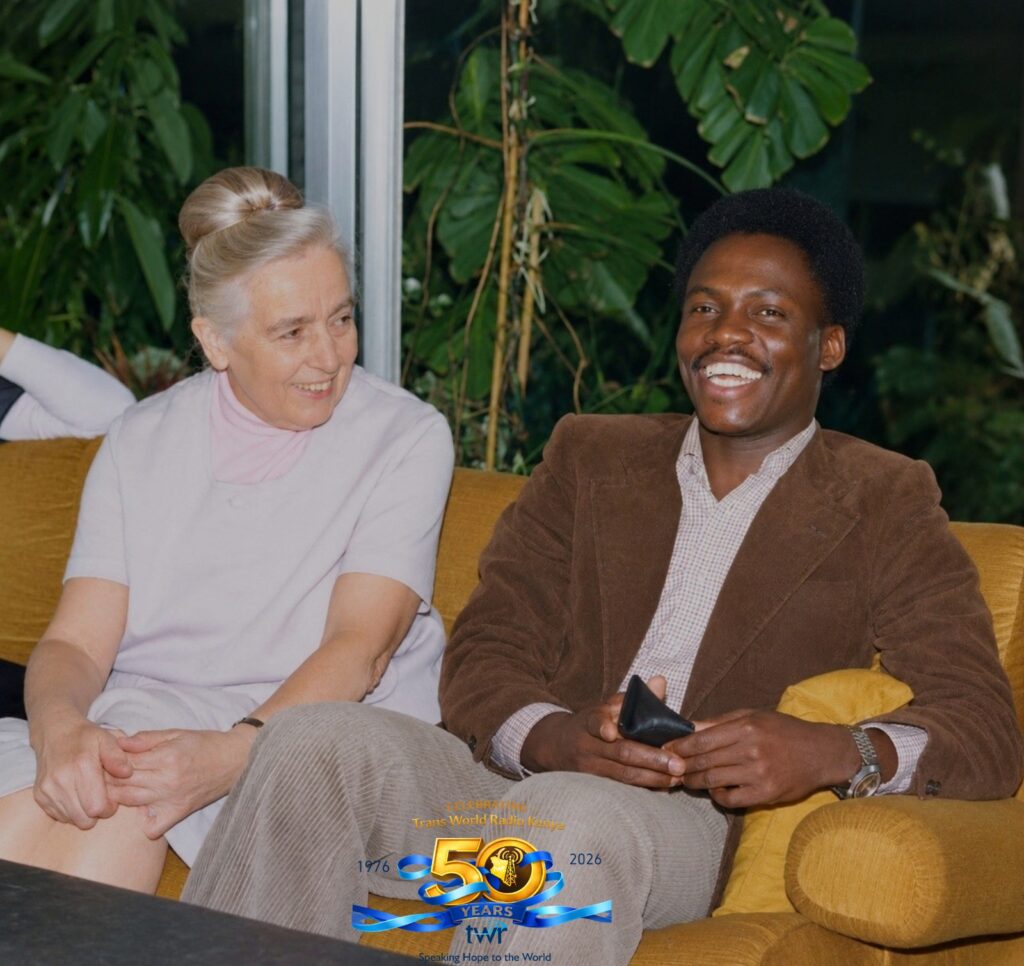
Through those broadcasts, Rev. Stephen began to see the possibilities of radio as a means of reaching people across geographical and cultural boundaries in Africa. He developed a desire to use media to serve Africa. His conviction was “Africa needs Jesus,” That conviction eventually brought him to the door of Rev. Horst Marquardt the director at Evangeliums Rundfunk -ERF in Wetzlar, Germany (ERF is the German’s National partner of TWR International).
The First “No”
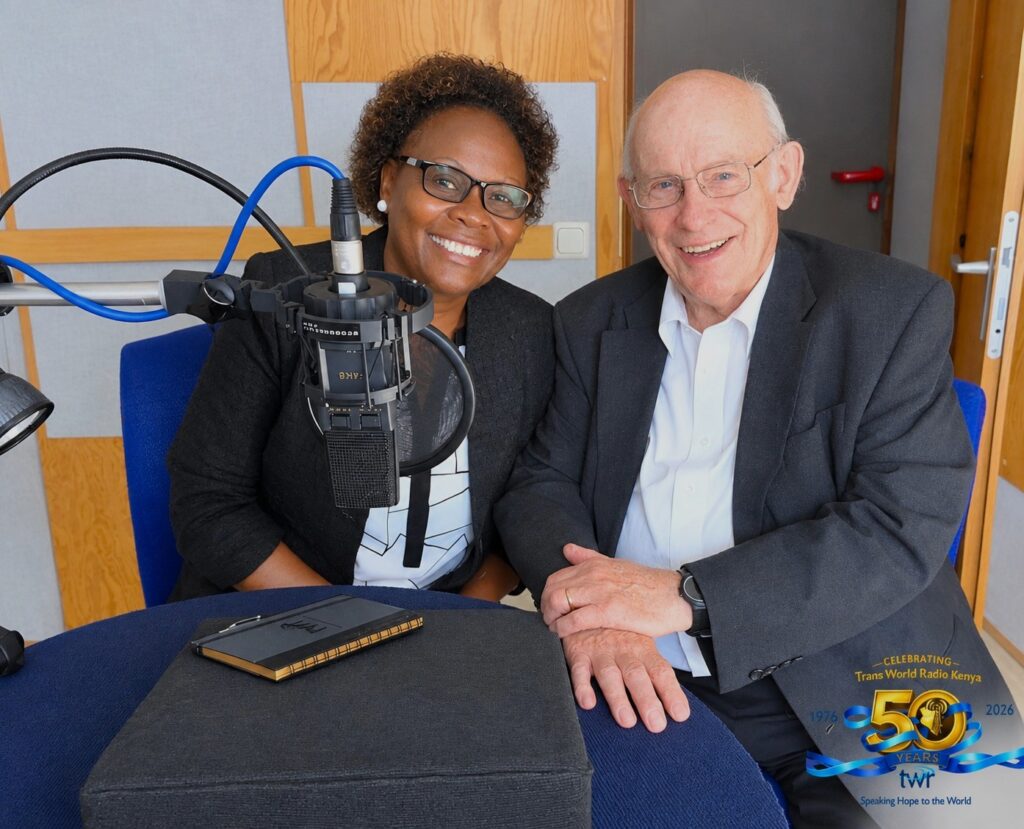
Years later, during an interview with former TWR Kenya Director Dr. Bernice Gatere, Rev. Horst Marquardt vividly recalled the day Rev. Stephen first came to see him. Stephen was accompanied by Mrs. Herta Wojahn and a German pastor who was a mutual friend of Rev. Marquardt and Mrs. Wojahn. They came with a simple question: “Was there an opportunity for this young African man to work in Christian broadcasting and serve his continent?”
There wasn’t.
He explained that there was no opportunity at the time. There was no transmitter or broadcasting facility available for Rev. Stephen to work with. Even if there had been, the ministry needed people with appropriate training people with theological education or experience in journalism and media. Rev. Stephen left.
For many people, that might have been the end of the journey. For Stephen, it became a challenge. If training was what stood between him and the opportunity, then he would get the training.
He Came Back
Two or three years later, Rev. Stephen returned. This time, he had followed the advice he received. He pursued theological education at Chrischona Theological Seminary in Switzerland, and the Methodist Church ordained him.
Surely, this time, the answer would be different. It wasn’t. Rev. Marquardt had to tell him No once again. There was still no opportunity for him at that moment. Rev. Stephen left disappointed, but he did not give up. Little did he know then, but an extraordinary turn of events would follow his second rejection.
Only two weeks later, Rev. Marquardt received a call from one of TWR’s international leaders. Following the successful establishment of TWR’s third transmission site at Mpangala Ranch in Manzini – Eswatini on November 1 1974, TWR now planned to set up a production station in Africa, and they needed someone who could help with the work.
He did not have to think for long.
The man who had come looking for an opportunity before the opportunity existed immediately came to mind: Stephen. He contacted Mrs. Wojahn and his friend and asked them to tell Rev. Stephen that there was now a place for him in Africa. In September 1975, Rev. Stephen joined ERF as an intern to train as a Radio Missionary.
The answer had finally come. But it had come at God’s timing, not Stephen’s.
Southern Africa was out of reach. East Africa Became the Way.
Even then, the path was not straight forward. TWR expected the production station to operate from Southern Africa, but apartheid-era realities made it difficult to send Rev. Stephen there. The transmission station was operating, but the geographical access and production presented a challenge.
Once again, the path had to change. After discussions with Rev. Stephen and others who understood Africa, another possibility emerged: Nairobi. At the time, Nairobi was already an important regional center, home to international organizations, receptive to the gospel, politically stable and a hub for decisions affecting much of the continent.
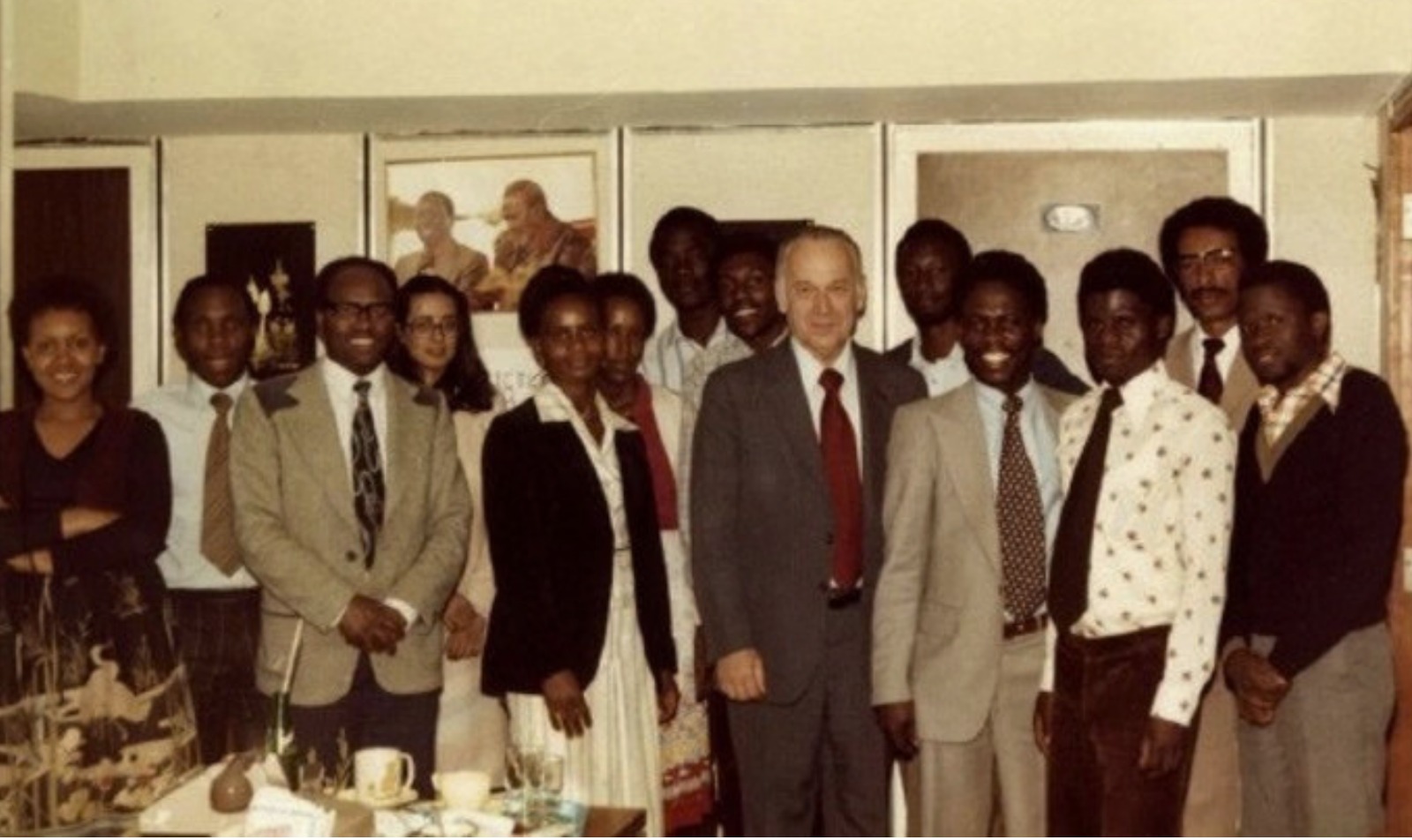
Rev. Stephen arrived in Kenya, but he was not walking into an established ministry. There was no established infrastructure, no functioning studio and no ready-made team. There was only the calling, the willingness to begin and the conviction that something could be built.
As Rev. Marquardt later remembered, Rev. Stephen was sent to Africa “into nothing.”
Rev. Stephen moved from his hotel room and eventually rented a two-bedroom apartment at Adams Arcade along Ngong Road, which served both as his home and as a recording and editing studio, recording under the blankets reading scripts from a flashlight. Later, Pastor David Mungai joined him. As the demand for more programs and staff grew the recordings moved to Nairobi Pentecostal Church studios on Valley Road, but the editing was at the apartment because there is where the revox reel to reel tape machines, accompanying reel tapes, cassettes were. .S Then they moved to a bigger office at Ufanisi House along Haile Selassie Avenue, just a short distance from the Kenyan Parliament. Before eventually finding a permanent home on Kamburu drive off Ngong road in 1982 thru the support of ERF / TWR.
The programs were produced in Nairobi for the Manzini station and transmitted through the shortwave across Africa. It was a complicated analogue process, far removed from the digital world of today.
But it was a beginning. And beginnings matter.
On August 6, 1977 in Kenya, Rev. Stephen married Grace from his home country, Ghana. Grace understood her husband’s ministry passion and gave him full support.
Two Men Who Became Partners
The story of Rev. Stephen and Rev. Horst was more than the story of an organization being established. It was the story of two men who developed a deep personal and ministry partnership.
Rev. Marquardt traveled to Africa around 30 times, and on many of those journeys he and Rev. Stephen traveled together through countries including Burundi, Zimbabwe, Malawi, Ghana, Mozambique and Angola. Their vision was not simply to broadcast programs from a foreign station. They wanted to see national offices established, with local studios, local staff and partnerships with churches in each country. They wanted the international character of TWR to take root within Africa
As the years passed, their relationship grew into one of trust and friendship. They spoke openly about their strengths and weaknesses, and when they traveled together, they began their days with prayer and Scripture.
Their closeness became so evident that their relationship was commonly compared to that of Paul and Timothy.
One incident captures the depth of their faith and friendship. On a flight from Abidjan to Burkina Faso, the captain announced that the aircraft had developed a problem and would have to return to Abidjan. The cabin fell silent. Rev. Stephen and Horst looked at one another, joined hands and prayed.
They then reassured the people around them: “Don’t be afraid. We are in the hands of our powerful God.”
The aircraft returned safely.
For Rev. Marquardt, the moment remained a vivid picture of the man Rev. Stephen was, a man who knew where to turn when circumstances were beyond his control.
The Man Behind the Mission
Rev. Stephen was known not only for his faith and determination but also for his warmth. Rev. Marquardt remembered his laughter, saying that people could hear Rev. Stephen laughing from other floors of the building and immediately know that he was there. Not forgetting his slogan of,
“Africa Needs Jesus“
Yet behind that laughter was a man with strong convictions, particularly about integrity.
Rev. Marquardt recalled an incident involving a vehicle that had been sent from Germany because Rev. Stephen traveled extensively in his work. When the vehicle became stuck in customs, an unofficial payment was expected before it could be released. He refused.
He chose to wait rather than compromise his convictions. He waited for months until eventually approaching a government official he knew, and the vehicle was released without the payment.
For Rev. Marquardt, the incident revealed something important about Stephen. He was thinking not simply about his own convenience, but about the kind of foundation and ministry they were building.
A Vision Bigger Than Broadcasting
The challenges facing TWR Kenya in those early years were enormous. Churches and leaders had to be convinced that mass media could be a powerful tool for Christian ministry. Financial resources were another challenge.
Rev. Stephen also carried a strong conviction that Africans themselves should participate in sustaining the ministry. Africa should not simply wait for resources to come from elsewhere. African Christians could give, participate and take ownership of the work. For this he used his networking gifting engaging partners within and outside Africa.
From friends and partners like Dr Sam Gordon, Peter Frei in Europe, Ray Alary in South Africa, Pastor Matsombe in Mozambique, among many others from different corners of the globe including Kenyan Church leaders like Rev. Dennis White (CITAM), Rev. Ambrose Nyangao of Parklands Baptist, Bishop Johanna Mbogori of the Methodist Church, Bishop Alexander Muge of the Anglican Church among others and government officials like Ambassador Bethwel Kiplagat. Rev Stephen was a servant of the people.
Rev. Marquardt remembers how he organized for a meeting with him and the first President of Kenya, President Jomo Kenyatta to discuss the Africa Challenge Project
As the work developed, the vision extended beyond simply putting Christian programs on the air.
Rev. Stephen, Rev. Marquardt and Dr. Paul Freed were among those involved in the Africa Challenge Project, an initiative that emerged during a period when parts of Africa were facing severe famine, hunger and other social challenges.
Programs addressed areas such as farming, health and HIV/AIDS awareness. The philosophy was simple: Pray and work.
People could pray for God’s help, but they also had a responsibility to act.
The technology would change. The countries would change. The methods would develop.
But the mission remained. To reach people with God’s Word. To speak hope. And in Kenya, that vision was beginning to take root.
A Legacy That Outlived the Men
Today, Dr. Paul Freed (died December 1, 1996), Rev. Stephen Boakye-Yiadom (died June 2, 2007) and Rev Horst Marquardt (died November 2, 2020) are no longer here to tell this story themselves.
But the work they helped set in motion remains.
That makes their story especially significant as TWR Kenya celebrates 50 years.
The international ministry that began with Paul Freed’s hesitant yes eventually crossed oceans and continents. Rev. Stephen carried that vision into Africa. Horst walked alongside him. Together, they traveled, prayed, planned, persuaded, built relationships and opened doors.
Rev. Stephen was told no.
Then he was told no again.
The door to Southern Africa was out of reach.
Nairobi became the way.
And what began with a young man working from a modest house in Nairobi would eventually grow into a ministry impacting people through multiple stations, languages and platforms.
But some questions remain: What happened after those first programs were recorded in Nairobi?
How did a ministry that began with one man, a borrowed opportunity and a two-bedroom house grow into an established work reaching communities across Kenya?
Who were the people who joined Rev. Stephen on the journey and how did he recruit ?
And what happened between that uncertain beginning and the ministry now celebrating 50 years of Speaking Hope?
The answer is where the next chapter begins.
Part 2: From “Into Nothing” to 50 Years of Speaking Hope. Watch out for Part 2 Tuesday 29th September