A Ministry Born Behind Closed Doors -Part 2– (Long Read) – By Geoffrey Otieno
What happens when one man refuses to let a “no” be the end of the story? Handwritten scripts and reel-to-reel tapes grew into powerful voices. Growing programs and FM stations widened the reach. This progression transformed a small beginning into a movement that has spoken Hope for 50 years.
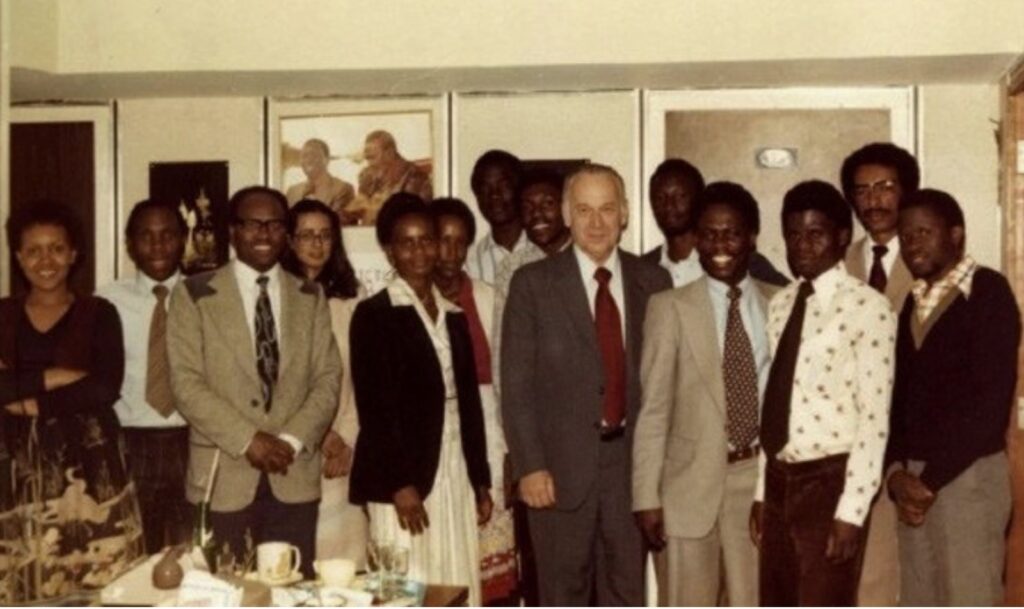
What followed after the team recorded the first programs in Nairobi? How did a ministry that began with one man, a borrowed opportunity and a two-bedroom house grow into an established work reaching communities across Kenya and beyond?
The answer lies not only in the programs and transmitters, but in the people who believed in the vision, opened doors, gave their time and used their voices to carry the Gospel further.
Building the Foundation
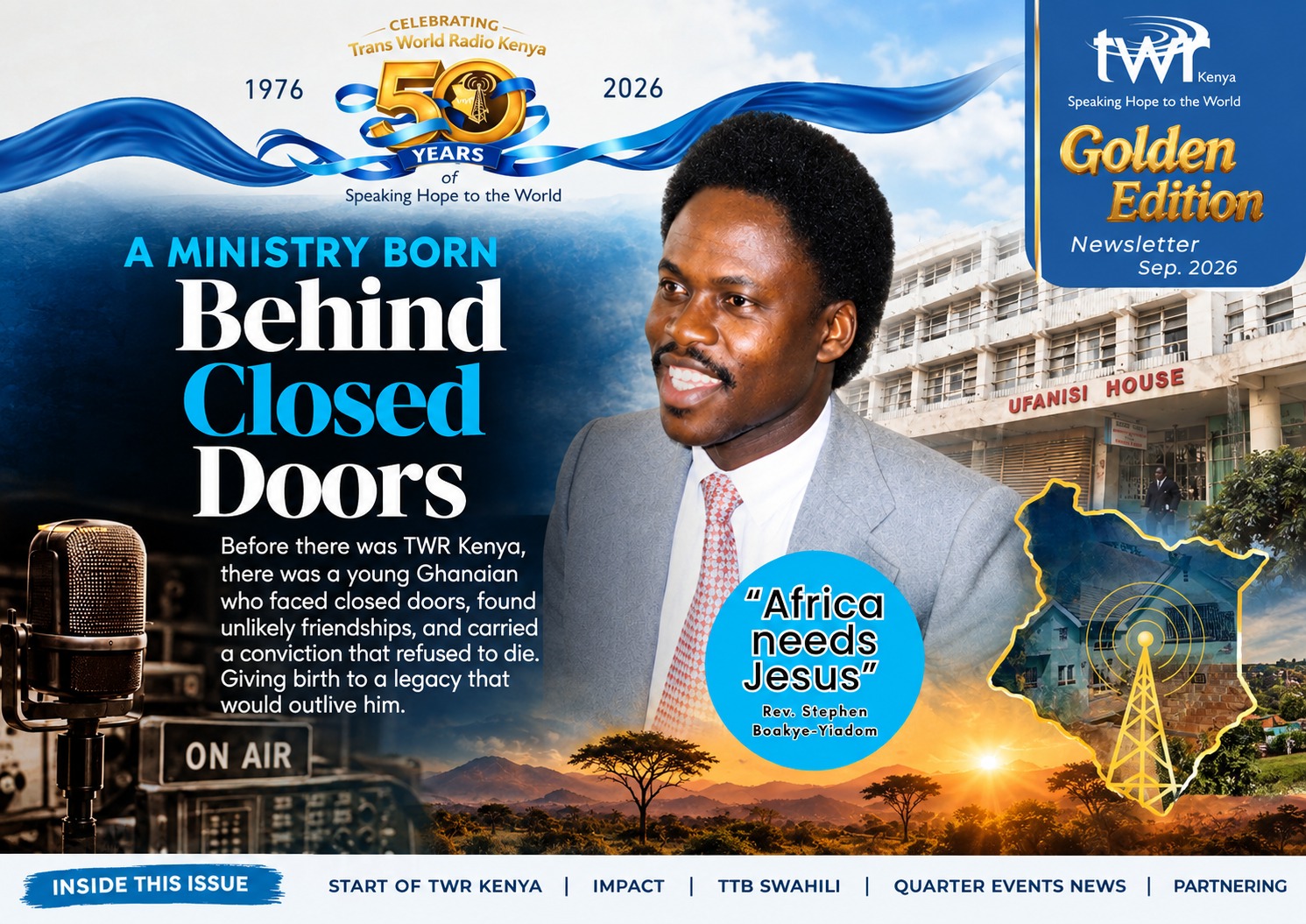
In the 1970s, the government owned radio in Kenya and used it mainly for news, politics, and public information. For Rev. Stephen Boakye-Yiadom, radio was something more. He saw the airwaves as an opportunity to take the Gospel beyond the walls of the church and into homes and communities that might never hear it from a pulpit.
Finding a place to work was one challenge. Finding people who shared his conviction was another.
Rev. Stephen had a gift for spotting people with passion and potential. He scouted churches, fellowships, universities and personal networks, looking for men and women who were willing to serve. He was not simply building a workforce; he was building a ministry.
One of the first people he recruited was Pastor David Mbugua Mungai. At the time, Mungai was working at Emmaus Bible School and occasionally leading services at Nairobi Chapel. During an evening service, Rev. Stephen approached him and asked to meet at Nairobi Baptist Church. He later arrived with Dave Adams, and the conversation continued over lunch at Ngong Hills Hotel.
Pastor Mungai accepted the invitation and became TWR Kenya’s first full-time producer and Office Manager. Before joining TWR, he had already been directing a thriving radio ministry at Emmaus Bible School.
The first board brought together leaders from across the Christian community: Bishop Johanna Mbogori of the Methodist Church as chairman; Rev. John Mpaayei and Bishop Ezekiel Birech of the AIC; Rev. Dr George Wanjau of PCEA; Rev. George Ochana, Vicar of St Christopher Anglican Church, Nakuru; Rev. Daniel Serwanga of Africa Evangelistic Enterprise; Mr. MacMillan Kiiru of World Vision International; Rev. Stephen Boakye-Yiadom as TWR General Secretary, Africa; and Pastor David Mungai as secretary to the board. Among the pioneering close associates were Justice Chris Okubasu and Dr Fred Ojiambo, High Court Advocate.
It was a small beginning, but the foundation was being laid.
The People Behind the Vision
Beyond his ability to spot talent, Rev. Stephen was a remarkable relationship builder. He maintained close relationships with partners and people he encountered along the way, and those who met him often remembered how easily he remembered them. He would hardly forget anyone after meeting them.
After Stephen’s marriage to Grace, Grace became affectionately known as “Mama Herta”. Meanwhile, Herta Wojahn took on an elevated role in the ministry, supporting her son’s work through prayer and giving gifts to every staff member on Christmas Day. A quiet but deeply personal expression of her love for the ministry and its people.
Rev. Stephen’s relationships became one of the ministry’s greatest assets.
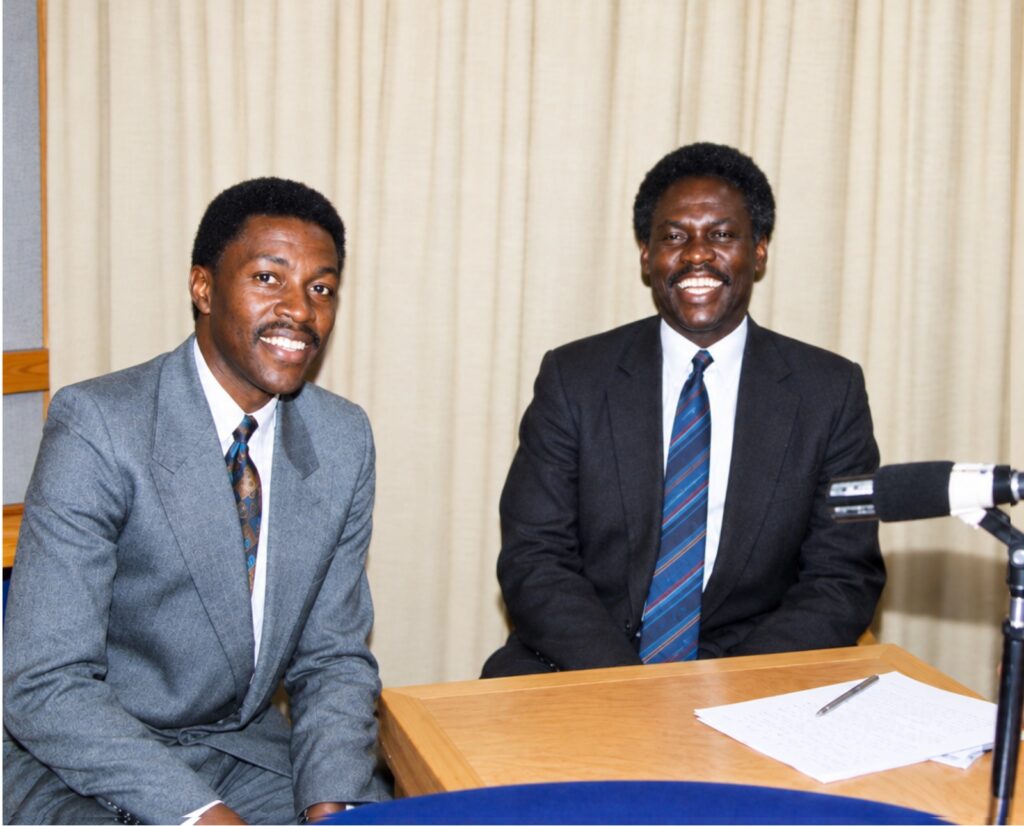
Rev. Kwame Rubadiri’s journey with TWR began even earlier, in 1976, when he was a student at the University of Nairobi and part of the vibrant youth fellowship known as The Revivals. Rev. Stephen met the young musicians through Africa Evangelistic Enterprise and was impressed by their passion.
He invited The Revivals to partner with TWR in reaching young people through music and creative programming. They recorded songs, discussions and drama at the modest Nairobi Pentecostal Church studio on Valley Road.
In 1979, Rubadiri was invited to join TWR but declined because he had joined Youth for Christ. A year later, in July 1980, he joined TWR Kenya. He would serve for 16 years and regarded Rev. Stephen as a big brother. His early training exposed him to communication and production, while Dr Dave Adams taught him recording, radio production and the art of connecting with different generations.
In September 1980, Rubadiri traveled to Swaziland for intensive orientation and training. There, he saw the possibilities of shortwave broadcasting and how the Gospel could travel across Africa and beyond.
Another familiar voice came through Rev. Ambrose Nyangao of Parklands Baptist Church. His connection to TWR began through Pastor Mungai, who conducted Bible studies at the University of Nairobi and Nairobi Chapel. Ambrose joined the fellowship and was eventually introduced to Rev. Stephen.
In the early 1980s, Rev. Stephen heard Ambrose preaching at Parklands Baptist Church. After the service, he told him that he wanted him on radio. He explained the TWR mission and invited him to take charge of Family Bible Hour program. At the time, the studios were at Ufanisi House, before the move to Kamburu Drive.
Rev. Ambrose agreed, and his voice soon carried biblical teaching and encouragement to listeners. He was also known for his iconic guitar singing and would later chair the SIFA board.
Dr Bernice Gatere was among those drawn into the growing work. A student passionate about communication, she wrote for Beyond and Step. One day, she found a note in her pigeonhole inviting her to meet Rev. Stephen. He entrusted her with scripts for Save Africa A Generation, which later became Africa Challenge.
“He told us from the outset that this was a faith ministry, and we trusted God for everything, including our salaries,” she recalled.
Then there was Daisy Mwanjama.
Around 1982, during a mission in Voi led by Rev. Stephen and Pastor Mungai, a young Daisy was among the crowd selling roasted maize. The message she heard that day stirred something within her. She decided to follow God and dedicate her life to serving Him.
After the mission, she accompanied Rev. Stephen and Pastor Mungai to Nairobi. Years later, she would serve faithfully as a producer, particularly in children’s ministry, helping shape the lives of young listeners through programmes such as Watoto wa Sifu.
From a House to a Ministry
The early production process was anything but sophisticated. The first studio was hired from Nairobi Pentecostal Church along Valley road. Rev. Stephen wrote scripts by hand because there was initially no secretary or typist. Programs were recorded at the NPC studio before the reel tapes were taken back to his house.
There, he physically cut and spliced the tape to remove mistakes.
As the work grew, it became clear that the administrative and production demands were too much for one person. The ministry moved from Adams Arcade to Ufanisi House on Haile Selassie Avenue, where more space was needed for a secretary, receptionist and technician.
Eventually, a single-storey house on Kamburu Drive, off Ngong Road, was acquired and transformed from a residence into offices and recording studios.
The new facility was dedicated on 30 August 1985 by Bishop Johanna Mbogori.
Boaz Otiende Olewe, who had served as an assistant to the contractor, remained as caretaker after finishing the construction. The growing facility eventually required two caretakers.
What had begun in a modest house was becoming an established ministry.
When Radio Began to Reach Further
With the new facilities came more programs and a wider vision.
New Dimension spoke to young people seven times a week. Climbing Higher aired for an hour each day. Thru the Bible Swahili, known as Neno Litaendelea, brought Bible teaching to Swahili-speaking audiences. Africa Challenge combined development issues with a Gospel perspective.
There was also Powerline, Shule Ya Biblia, Kuwa Katika Imani, Watoto wa Sifu and a Somali devotional program.
The ministry was learning that radio could respond not only to spiritual questions, but also to the realities confronting its listeners.
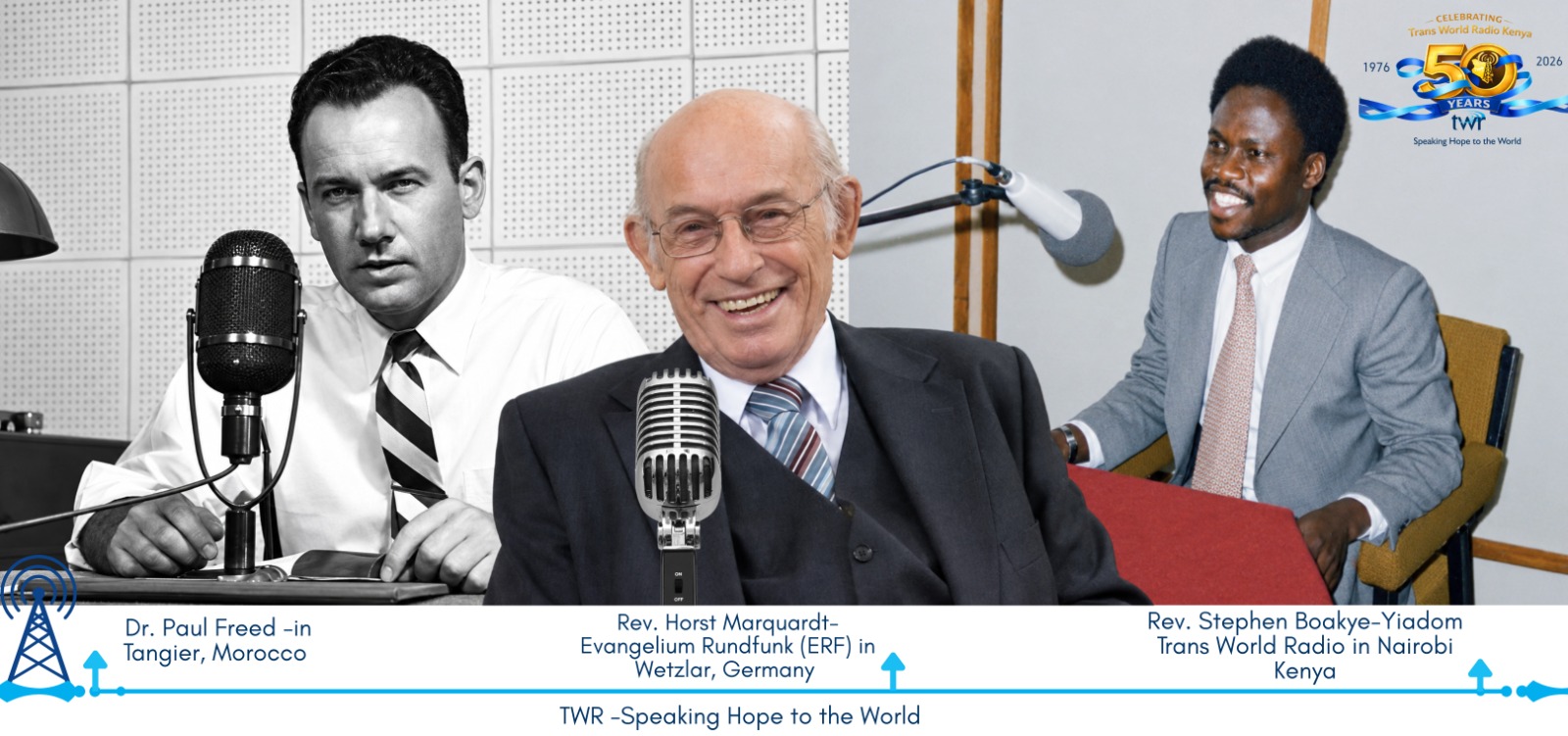
Between 1983 and 1985, famine in Ethiopia brought widespread suffering. The crisis prompted TWR founder Dr Paul Freed to initiate a Gospel radio programme addressing the issue. Africa Challenge developed with food security among its major themes, presenting the crisis through a Gospel perspective.
Youth programming also continued to grow, with programs such as Breakthrough and New Dimension gaining a following. Powerline provided daily devotional content, alongside sponsored productions such as Words of Hope.
Then came another crisis.
In the early 1990s, the AIDS pandemic was devastating communities across Kenya. After years of denial, the reality could no longer be ignored. Africa Challenge began addressing the issue through weekly themes, while a special programme, Asali Iuayo, was introduced.
The radio ministry was no longer simply filling airtime. It was engaging with real life.
Rev. Stephen also believed strongly that Africans should participate in sustaining the ministry. Africa, he believed, should not simply wait for resources from elsewhere. African Christians could give, participate and take ownership.
His ability to build relationships became important in developing partnerships both within and beyond Africa.
From Kenya to Africa
By the early 1990s, TWR was entering another important chapter. There was strategic ministry restructuring thereby decentralizing the worldwide ministry through regional directors in six regions. TWR-Africa became the first region to take this structure forward, and in 1992 Rev. Stephen became its first Regional Director for Africa.
South Africa emerged from apartheid. Nelson Mandela became President. TWR selected Johannesburg for the Africa Regional Office.
Rev. Stephen, now a father of four, moved to Kempton Park, Johannesburg, to establish the new office.
Nairobi became the national office, with Rev. Kwame Rubadiri becoming the first National Director and CEO of TWR-Kenya. His wife, Emmy, who had headed the youth department, stepped back from the role.
Rev. Rubadiri later left for ministry in the United States. Dr Stephen Njiro succeeded him for a short period before the board appointed Rev. Daniel Serwanga. He was later succeeded by Dr Bernice Gatere, who became the first woman National Director in 2001.
The story was changing shape. What had started as one man’s conviction in Nairobi had become part of a growing African broadcasting movement.
The People Who Helped Build the Journey
Behind the growth of TWR Kenya are generations of staff whose service helped shape the ministry. Former staff members such as Chris Basilrwa, Pauline Ngunjiri, Nilam Verma, DavidAngango, Faith Muthuku, Emmy Rubadiri, Pastor Geoffrey Wainana, Jacqueline Fusala Fanuel Angote who served as a driver and was affectionately regarded as the ministry’s “ground pilot,” Beverly Otanga, Pamela Omwodo and Nelly Kiiru, among many others, each played a part in building the ministry we know today.
Some of these faithful servants have since passed on, but their contribution remains part of the TWR Kenya story. There are far too many names to mention them all, but we remember and honor the men and women those still with us and those who have gone before us whose service, sacrifice and commitment helped build the ministry and carry its message to generations of listeners.
The Legacy Lives On
The journey, however, also carried moments of deep loss.
In 2004, the sudden death of immediate past National Director Rev. Daniel Serwanga shocked the team. Rev. Stephen and David Tucker attended the memorial service at All Saints Cathedral in Nairobi, with David Tucker serving as TWR president at the time.
Three years later, another call brought devastating news.
In 2007, while the leadership team was in Johannesburg, a Sunday phone call announced that Rev. Stephen had died.
The team grieved, prayed together, signed a card and the obituary book. Rev. George Wanjau presided over a memorial service at St Andrew’s Church later.
By then, the ministry Rev. Stephen had helped establish was entering a new era.
In 2005, authorities secured licenses and frequencies to begin FM broadcasting in Voi, Lodwar, Marsabit, Garissa, Wajir, Lamu, and Mandera. In 2008, FM broadcasting began, with SIFA Voi becoming the first station to go on air.
Today, we are also in Kakuma, Loyangalani, Wajir Mandera, while TWR produces more than 25 programmes in more than 15 languages from Nairobi, reaching audiences through SIFA FM, and partner stations locally and regionally.
Behind that growth are countless people.
From a young Ghanaian who refused to give up after hearing “no”, to a ministry operating from a modest house; from handwritten scripts and reel-to-reel tapes to FM transmitters, digital platforms and programmes in more than 15 languages, the journey of TWR Kenya has always been about people.
People who believed. People who gave. People who opened doors. People who used their voices. People who prayed. People who partnered. And people who listened.
Rev. Stephen may no longer be here to see the ministry he helped build celebrate its 50th anniversary, but his legacy lives on in the people, partnerships and platforms that continue to carry the message across the country and beyond.
Fifty years on, the story continues. TWR Kenya is still Speaking Hope to the World.